I’ll start by saying that completing this dissertation was by far the most difficult thing I’ve done in my entire life.
I was really honoured (and humbled, almost too humbled) to have my PhD program funded in its entirety by the ERC (European Research Council) and SSHRC (The Social Sciences and Humanities Research Council). During the program, I can only imagine I suffered as much as the average grad student from imposter syndrome. It’s an odd experience learning to be a professional researcher while pretending you are already a professional researcher at the same time.
I got to read medieval manuscripts. I got to live for 6 months in Dublin, Ireland. I got to wait out the COVID-19 pandemic in style.
And here we are.
Maybe the large portion of the value of initiatory exercises like PhD dissertations is just to discover that you are able to do it.
This dissertation investigates a tiny corner of the vast corpus of medieval literature on a tiny Handbook on Metaphysics from ninth-century Baghdad known as “The Book of Causes.” Authors in the Latin Christian world were especially enamoured with this text that adapts the pagan and polytheistic metaphysics of the late-ancient Greek philosopher Proclus (who I wrote [[matter-and-the-one-in-proclus|my Master’s thesis on]]) into the conceptual framework of the Abrahamic religions. I focused on the three commentaries on the Book of Causes that were classics in the later medieval period by Albert the Great, Thomas Aquinas, and Giles of Rome.
The focus of this research was the concept of celestial animation.
Work is in progress to turn some of these chapters into standalone journal articles.
Noble Soul and the Metaphysics of Celestial Life in the Liber de causis Commentaries of Albert the Great, Thomas Aquinas, and Giles of Rome. PhD diss., University College Dublin, 2024.
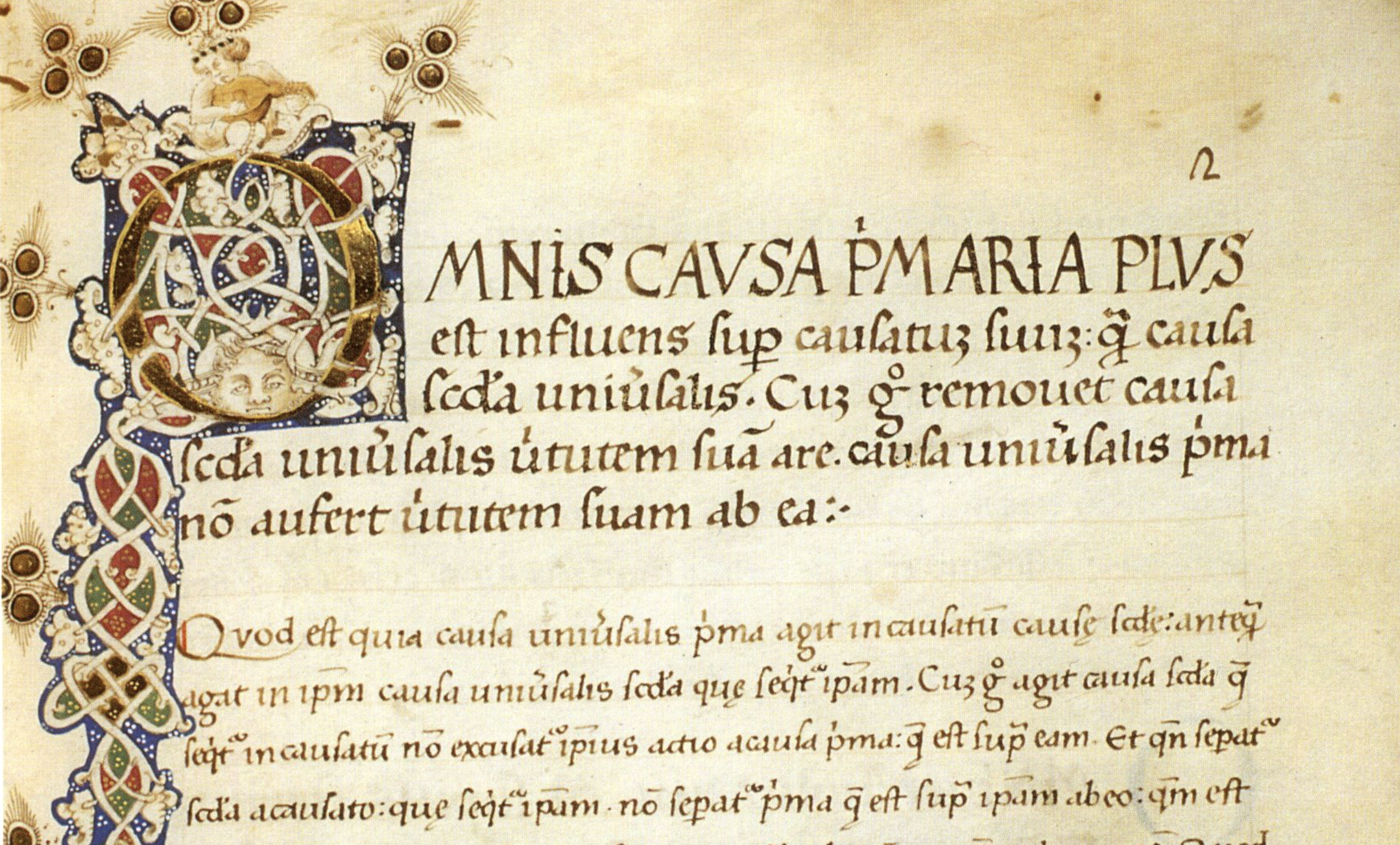
Image: detail from a 15th c manuscript of the Liber de causis, BNM ms Lat. Z. 288, fol. 2r.